Ice Maker Repair · River West
The Ice Maker Stopped: Check the Water Before the Module
Put together by
Rosalind Okafor
Refrigeration technician — dual-refrigeration and column units · 22 years in the trade
Treats a dual-refrigeration cabinet as two machines that happen to share a door line, and diagnoses the halves separately. The evaporator that frosts and the one that never does are rarely failing for the same reason.
EPA 608 certified
Licensed, bonded and insured — licence number on request.
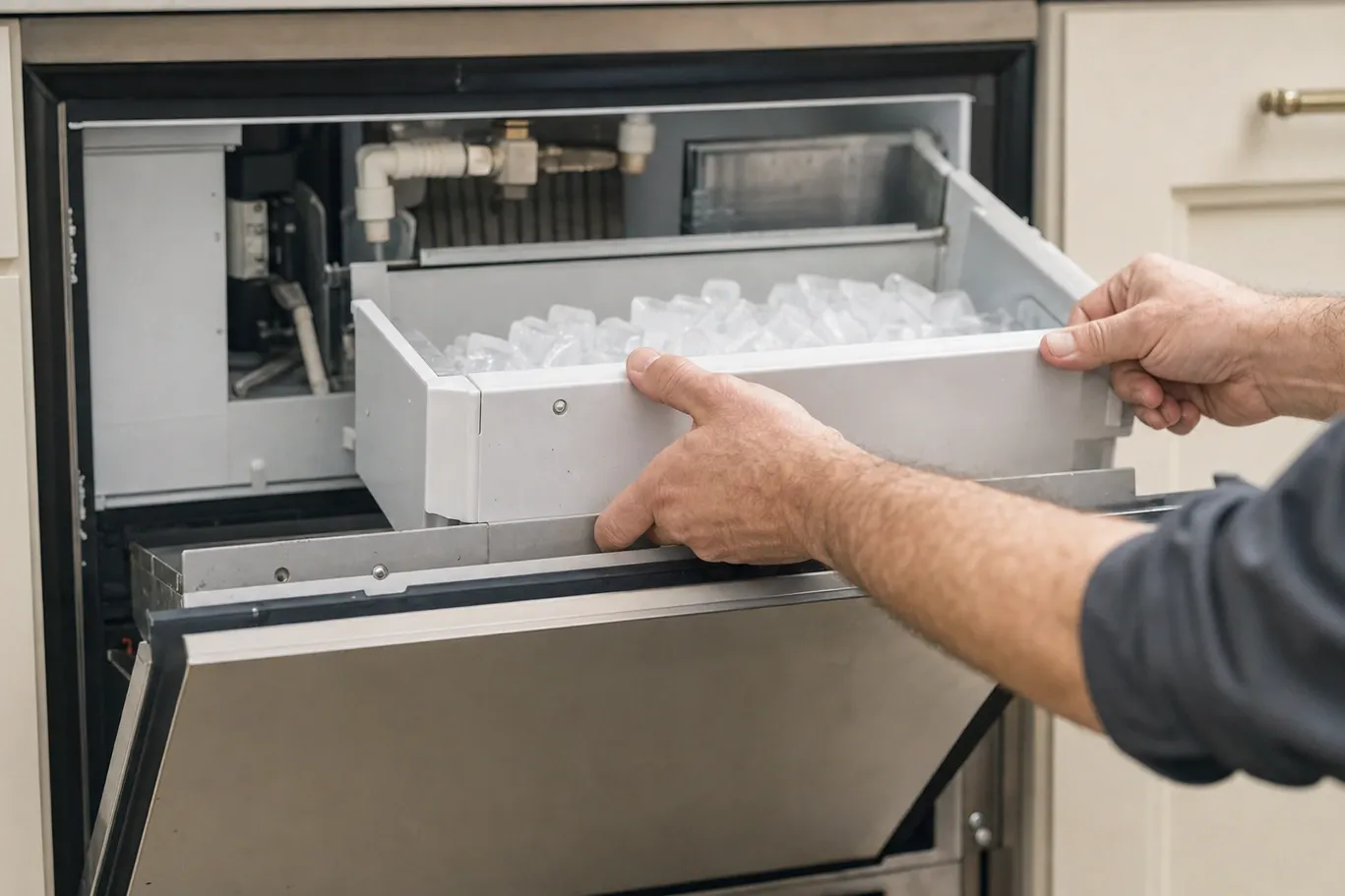
An ice machine that has gone quiet gets diagnosed backwards more often than any other refrigeration fault in the city. The bin is empty, the module is the moving part, so the module gets blamed and quoted for. About half the time the module is fine and has been fine all along — it has simply not been given enough water to make a cube out of.
That is worth knowing before you book anything, because the two faults look identical from the kitchen and are separated by a measurement that takes a couple of minutes.
Why the supply gets missed
A built-in ice machine is fed by a line that starts at a valve somewhere else entirely — under a sink, behind a stack, occasionally in a cupboard on the other side of the wall — and travels to the machine through whatever route the kitchen fitter could find. Along the way it passes a filter cartridge and an inlet valve, either of which can quietly reduce the flow without ever stopping it.
Converted warehouse floors make this worse than it needs to be. When the entertaining end of a floor is a long way from the riser, the run to the machine is long, has more joints in it, and is more likely to have been pinched behind a cabinet at some point. The machine at the end of that run is the first appliance in the flat to notice a pressure problem, because it is the only one that needs a precise volume of water in a fixed number of seconds.
What a starved machine actually does
A module that is not getting its fill volume does not stop. It carries on cycling, which is what makes it so convincing.
- The mould fills part way, so the cubes come out short, hollow or with a dished top. They collapse in a glass rather than melting.
- Harvest still runs on time, so you hear the machine working through the night and reasonably conclude that it is trying.
- The bin fills slowly or not at all, because most of what is being made is falling apart on the way down.
- In a bad case the fill overshoots somewhere it should not, water runs down the back wall, and it freezes into a ramp under the module — which then gets read as a leaking module.
A module that has genuinely failed behaves differently: it stops mid-cycle and stays there, or it never begins a harvest at all, and the mould is either bone dry or holding one solid slab that never releases.
Three things worth checking yourself
None of these needs a tool you do not already own.
Find the shut-off valve and confirm it is fully open. Quarter-turn valves get knocked closed during work under a sink and nobody notices for weeks, because everything else on that supply still runs perfectly well.
Check how old the filter cartridge is. If nobody can remember changing it, that is the answer often enough to be worth doing before anything else. A cartridge that has been in place for years is a restriction with a filter printed on the side.
Watch one full cycle. Open the door, look at the mould, and stay there. You are after one thing: does the water fill the mould to the top edge, or does it stop short? A mould that fills correctly and then produces bad ice is a genuinely different problem to one that never fills.
What is not worth doing is switching the machine off overnight to reset it. There is nothing to reset. All you lose is the temperature the bin had, and the next morning the first cubes will be worse rather than better.
Scale, and why Chicago machines get it
Lake water is not aggressive, but it is not soft either, and a clear-ice machine runs water over a plate continuously to grow a cube. Anything dissolved in that water stays behind when the ice leaves.
Over a few years that shows up as a film on the evaporator plate, scale in the drain trap, and a cube that takes longer to release than it used to. The machine compensates by running the harvest longer, the cycle count drops, and the bin level falls off gradually enough that nobody can say when it started. It is a cleaning and descaling job rather than a repair, and a machine that has never had one is usually due.
Two symptoms tell you scale is involved rather than supply: the cubes are full size but cloudy, and the harvest takes noticeably longer than it did — you can hear it. Supply faults make small cubes. Scale makes slow ones.
When it is worth calling somebody
Ring when the fill is right and the ice is still wrong, when the machine has stopped mid-cycle and stayed there, or when there is water anywhere it should not be. Those three are not going to resolve themselves and are not DIY territory — the fill valve is a live component and the drain pump on a clear-ice machine sits under everything else in the cabinet.
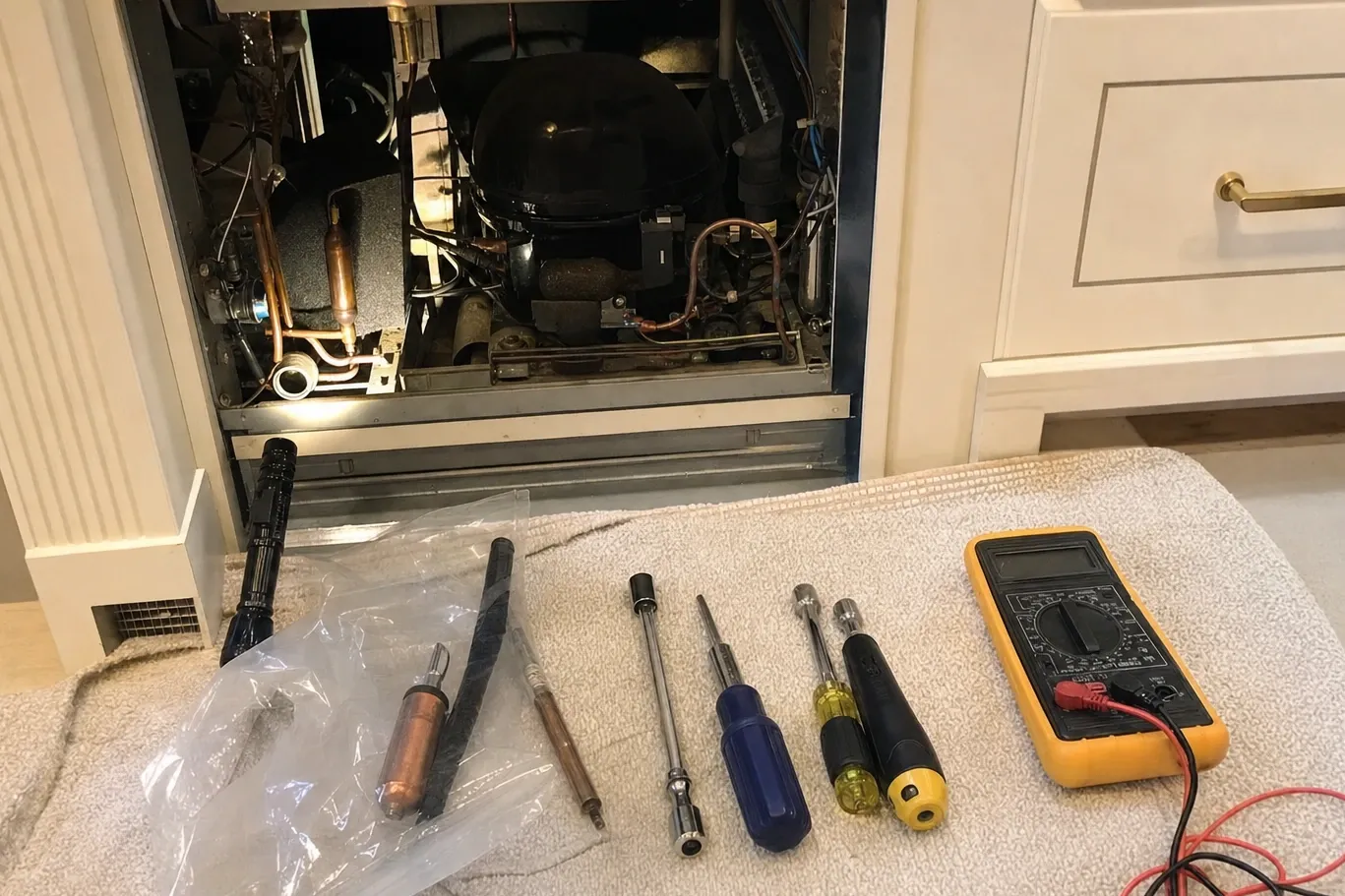
The visit starts at the supply either way: static pressure at the valve, fill volume measured over a complete cycle, filter age, then the module. Doing it in that order is what stops a working module being replaced, and it is why the first thing dispatch will ask you is where the shut-off valve is.
Follow-ups
- How long should a machine take to start producing again after it has been off?
- Give it a full day. A machine that has been switched off, moved or had its water shut has to chill the mould down and complete a couple of cycles before the bin starts filling at a normal rate. Judging it after two hours is how a healthy machine gets condemned.
- Is a filter change something I can do myself?
- On most undercounter machines, yes — the cartridge is behind the grille and quarter-turns out. What matters is doing it before it becomes the diagnosis: a cartridge that has been in place for years is a restriction, not a filter, and it will starve the fill valve long before it stops cleaning anything.
- The cubes are cloudy rather than clear. Is that the same fault?
- Different one, usually. Cloudiness comes from air and dissolved minerals freezing into the cube, which points at water chemistry or at a cycle that is freezing too fast. Hollow or undersized cubes are the fill fault. Cloudy but full-size cubes are worth mentioning but rarely worth a visit on their own.