Freezer Repair
Frost That Keeps Coming Back Is Not a Cleaning Problem
Put together by
Rosalind Okafor
Refrigeration technician — dual-refrigeration and column units · 22 years in the trade
Treats a dual-refrigeration cabinet as two machines that happen to share a door line, and diagnoses the halves separately. The evaporator that frosts and the one that never does are rarely failing for the same reason.
EPA 608 certified
Licensed, bonded and insured — licence number on request.
Every freezer makes frost. Warm air carries moisture, the moisture meets the coldest surface in the cabinet, and it freezes there — that is the machine working as designed, and a defrost cycle clears it several times a day without anyone knowing.
So the question is never whether there is frost. It is whether the frost is being cleared. A layer that comes back within a week of being scraped out has told you that the defrost cycle is not completing, and no amount of clearing it by hand changes that.
What a defrost cycle is meant to do
Several times a day the cabinet stops cooling for a few minutes and warms one specific part of itself on purpose. A heater beside the evaporator coil melts the frost off it, the meltwater runs down into a drain trough, out through a tube, and into a pan near the compressor where it evaporates away.
Three things have to work for that to finish: the heater has to come on, the control has to run the cycle long enough, and the water has to get out. Any one of them failing produces the same visible result — ice — but a different pattern, and the pattern is what makes the diagnosis quick.
Reading the pattern before anyone visits
You can get most of the way there by looking, and it costs nothing.
- Ice on the back wall, thick and even, growing over weeks. The frost is being made and never melted. Points at the heater or at the control circuit that runs it.
- Ice at the bottom of the compartment, or a sheet across the floor, with the walls fairly clear. The frost is melting and the water is not leaving. Points at a blocked drain tube — very common, and one of the cheaper repairs.
- Ice on the fan blades or a rattling, scraping note when the door opens. The fan is hitting ice that should not be there. Same root cause as the first one, usually further along.
- Frost only around the door edge, the seal, or one corner. Not a defrost fault at all. That is warm room air getting in, and it is a gasket, a hinge or a cabinet that is not sitting square.
That last one is worth separating out, because it is the one people fix themselves and the one that gets misdiagnosed as a defrost problem most often.
Why kitchens here make it worse in winter
The intuition is that a cold flat is easier on a freezer. It is not, particularly.
From November the heat comes on and kitchens run dry and warm at floor level for months. Gaskets that have gone stiff with age stop taking the shape of the frame the way they did, and a door that eases open a fraction after being closed lets a steady trickle of room air into the compartment all day. That air brings moisture, the moisture becomes frost, and a defrost cycle that would have coped in September falls behind.
Then in August the same cabinet gets genuine humidity instead, and the marginal seal that had been getting away with it produces ice within days. Both ends of the year expose the same slack gasket for opposite reasons, which is why a seal that gets checked in spring saves a call in both seasons.
What actually gets tested on the visit
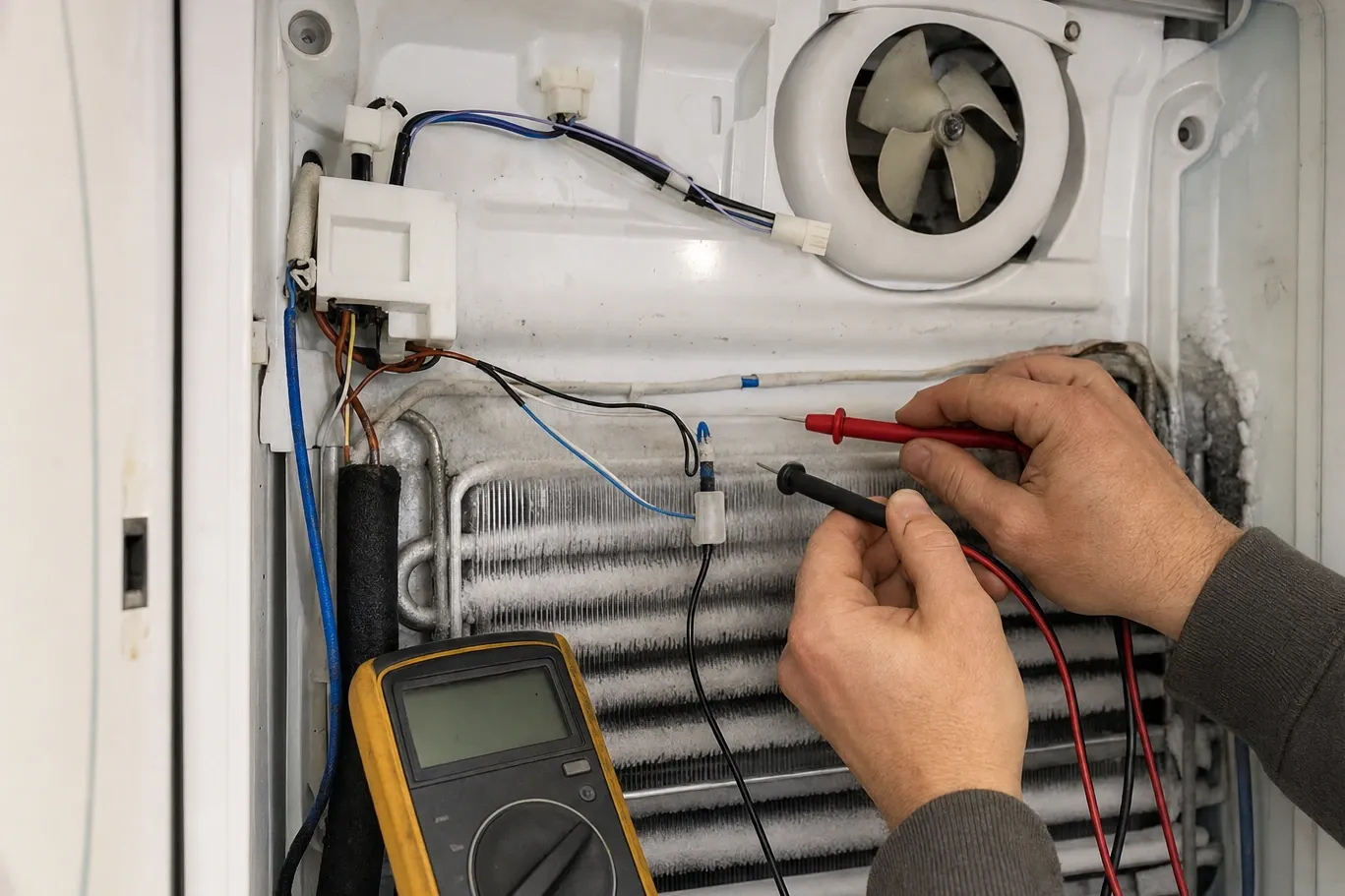
The defrost cycle is forced and watched all the way through rather than inferred from where the ice has settled. That means the heater, the terminator that cuts it off, and the sensor the control is reading are all metered under load — a heater that is open circuit reads obviously dead, but a terminator that opens early looks perfectly healthy until you watch a whole cycle.
The drain trough and tube get cleared and flow-tested, because a tube that passes water on a bench can still ice up in situ. The evaporator fan gets a current reading and a clearance check. And the compartment temperature is logged at the shelf with a probe against the setpoint on the panel, because soft ice cream with a display insisting on zero is the other shape this fault takes: the compartment is warmer than the board believes, and the sensor is usually why.
Two things follow from that. The diagnosis is short — most of it is done inside the first half hour — and it does not require the cabinet to be pulled out of its joinery, which on the kitchens around here matters more than it sounds.
When to stop clearing it and book
Clear it once, note the date, and see how long it takes to come back. Under two weeks means the cycle is not completing and it will keep happening. Water on the floor means the drain, and that one gets worse rather than plateauing. A scraping fan means ice is already in contact with a moving part.
None of those improve with time, and all three are ordinary repairs rather than sealed-system work. The service call is flat and comes off the repair, so the diagnosis is not the part worth putting off.
Follow-ups
- How much frost is normal?
- A light bloom on the walls after a party, gone again within a day or two, is the cabinet doing its job. What is not normal is a layer thick enough to feel through a glove, frost that forms in the same place every time, or ice that survives a full defrost cycle. Normal frost disappears on its own; a fault does not.
- Will emptying and defrosting it fix anything?
- It buys weeks, not a repair. Clearing the ice by hand resets the symptom while leaving the cause — a heater that never came on, a drain that is blocked, a fan that is not moving air — exactly as it was. It is worth doing before a visit only if the compartment is so iced that nothing can be tested.
- The freezer works but the fridge side has gone warm. Same fault?
- Often the same root, yes. On a cabinet where one evaporator feeds both compartments through a duct, an iced evaporator starves the fresh-food side first while the freezer carries on looking healthy. A warm fridge with a fine freezer is one of the strongest pointers to a defrost fault there is.